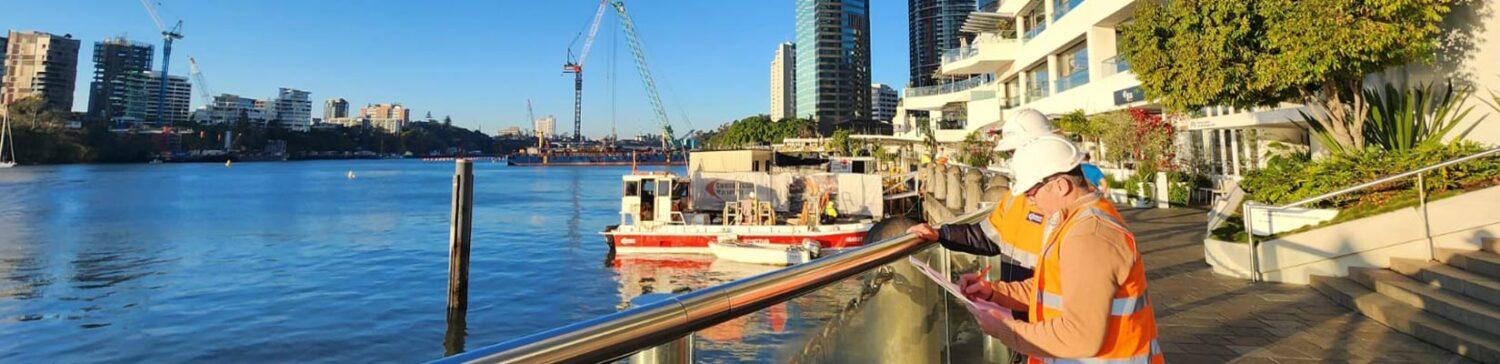
Marine Construction Engineering
Bridging the gap between the drafting table and physical subsea installation. Precision engineering tailored for active marine channels.
Maritime designs built for flawless execution
CMG’s dedicated engineering division operates directly alongside our offshore vessels and dive crews. We combine structural mathematics (conforming to AS4997 and AS3600) with hands-on diving construction experience to deliver maritime works that are safe, compliant, and highly cost-efficient to build.
Specialist Engineering Services
Durability through technical precision.
MARITIME STRUCTURAL DESIGN
Comprehensive RPEQ-certified engineering of maritime assets, including commercial wharves, heavy-duty jetties, sheet-piled seawalls, suspended public walkways, and boat ramps, designed in strict accordance with AS4997.
TEMPORARY WORKS DESIGN
Engineering of mission-critical temporary marine works, including hydrostatic-seal cofferdams, custom subsea piling templates, modular crane-barge outriggers, and dynamic subsea lifting frames.
REMEDIAL & FORENSIC ENGINEERING
Comprehensive structural diagnostics utilizing non-destructive testing (NDT), remaining service life modeling, pile integrity surveys, and custom sacrificial or ICCP cathodic protection array designs.
HYDRODYNAMIC & SCOUR ASSESSMENT
Computational hydrodynamic modeling of tidal velocities and river shear stresses to design robust rock-armour riprap layers, geotextile filters, and articulated concrete block scour matrices.
3D BIM & SUBSEA MODELING
Advanced CAD, 3D modeling, and BIM coordination designed to merge terrestrial structures with high-resolution subsea multi-beam bathymetry datasets, eliminating subsea clash risks during installation.
COMPLIANCE, CERTIFICATIONS & AUDITS
RPEQ sign-offs, formal load rating reassessments, structural integrity audits, and regulatory certifications aligning critical infrastructure with Queensland TMR and Port of Brisbane guidelines.
An Integrated System
We remove the disconnect between drafting computers and offshore deployment. Our unified ecosystem coordinates structural designers directly with marine vessels and subsea installation crews.
IN-HOUSE RPEQ ENGINEERING
Our in-house registered professional engineering team designs structural works specifically optimized for marine environments, avoiding over-scoped designs.
DIRECT DIVE INTEGRATION
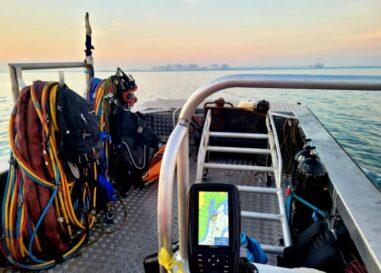
ADAS diving crews inform our engineers during initial assessments, utilizing subsea multi-beam scanners, ultrasonic imaging, and real-time dive video loops.
VESSEL & RIGGING OPTIMIZATION
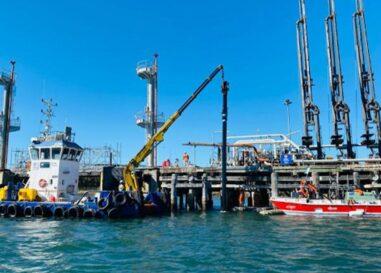
Temporary works, cofferdams, and piling templates are custom-engineered to match the deck spaces and crane lifting limits of our in-house marine barges.
Frequently Asked Questions
Technical insights regarding our marine engineering and compliance methodologies.
How do CMG engineers design temporary cofferdams and piling templates for the high-velocity, high-current zones of the Brisbane River?
We design temporary works, such as modular cofferdams and piling templates, utilizing advanced hydrostatic pressure and tidal shear velocity modeling. Structural elements are calculated using finite element analysis (FEA) to withstand extreme drag forces and rapid tidal shifts characteristic of the Brisbane River. All templates incorporate dual-axis leveling jacks to allow our barge-mounted cranes and ADAS-certified divers to set piles within millimeter tolerances. Every temporary design is fully RPEQ certified to guarantee safety during high-risk marine operations.
What non-destructive testing (NDT) methodologies do you employ to assess subsea pile degradation and remaining service life?
To evaluate steel, concrete, and timber pile integrity without damaging the parent material, we employ a suite of NDT methods. This includes Ultrasonic Thickness (UT) testing on steel piles to calculate actual parent metal loss against nominal design specifications, and Pile Integrity Testing (PIT) using low-strain sonic echo mechanics to detect deep internal concrete structural voids. We also perform electrochemical potential mapping on reinforcing steel to measure corrosion cell activity, which feeds directly into our remaining service life models aligned with AS4997 standards.
How are scour protection systems engineered and modeled to withstand both standard tidal cycles and major flood events?
Our engineers analyze local hydrodynamic profiles and river floor shear stresses to model scour behavior. Using the Isbash and Hudson riprap equations, we calculate the required rock armour diameter and grading size necessary to remain hydraulically stable under extreme flow rates. To prevent the migration of subsea fines through the riprap, we specify needle-punched non-woven geotextile underlay filters. In highly confined or turbulent areas, we engineer articulating concrete block mattresses (ACBM) that adapt directly to changing bathymetry while resisting uplift.
What structural standards and material exposure classifications guide your design for reinforcing marine concrete in Brisbane splash zones?
In subtropical environments like Brisbane, splash zones present extreme wet-dry cycles that accelerate chloride ion ingress. Our engineering conforms strictly to AS3600 exposure classification C2. We specify high-durability concrete mixes incorporating supplementary cementitious materials (SCMs) such as fly ash, slag, or micro-silica to reduce concrete permeability. Furthermore, we mandate strict reinforcement cover depths, specify galvanized or stainless steel reinforcement in highly volatile splash horizons, and design galvanic sacrificial anode systems to halt active corrosion cells.
How does CMG ensure that theoretical engineering designs can be practically and safely constructed underwater?
This is where our in-house constructability loop shines. Our engineering team doesn’t design in a vacuum; they work alongside our ADAS-certified commercial divers, vessel masters, and fabrication workshop. Prior to mobilization, we model every step of subsea assembly in 3D to identify and eliminate subsea rigging clashes and safety hazards. By anticipating low-visibility, high-current environments during the design phase, we engineer simplified, modular subsea connections (such as tapered guides and self-centering pin connections) that minimize diver time on the seabed and significantly reduce project risk.